February 2021: Generative Entanglements
What’s Inspiring Me Now
- The latest episode of Robyn Love’s Small Things Brought Together with artist Roberta Aylward. After watching, I immediately went into my studio and started painting!
- Elena Ferrante’s Neapolitan Novels. I know I’m a little late to this party and WOW. Give Book 1 at least 100 pages before deciding. Book 2 and 3 are outrageously good. Felt SO DELICIOUS to be lost in these for days on end. Still haven’t finished Book 4 tho; don’t want them to end!
- Merlin Sheldrake’s Entangled Life. Highly recommend the audiobook. Sheldrake himself reads it in his very sexy, very chill high British accent. MIND BLOWER.
- Mary Ainsworth Secret Teachings Study Group with Bethany Saltman. It’s FREE, it happens once a month. There are Venn diagrams and microscopic dissections of relational interactions and learning how to love yourself and others and the world using the precise and genius teachings of Mary Ainsworth. Can’t recommend enough!
- Three-dimensional art—my own and others. Shadow boxes, dioramas, faerie houses, sculpture. Maybe having so many of my social interactions reduced to two dimensions has made me long for the third dimension in creative work?
- The Octavia’s Parables podcast with adrienne maree brown and Toshi Reagon. It doesn’t matter if you’ve read Octavia Butler’s Earthseed books. Butler saw all of it—everything that’s happening now. And brown and Reagon are amazing guides through the territory, with incredible questions at the end of each episode.
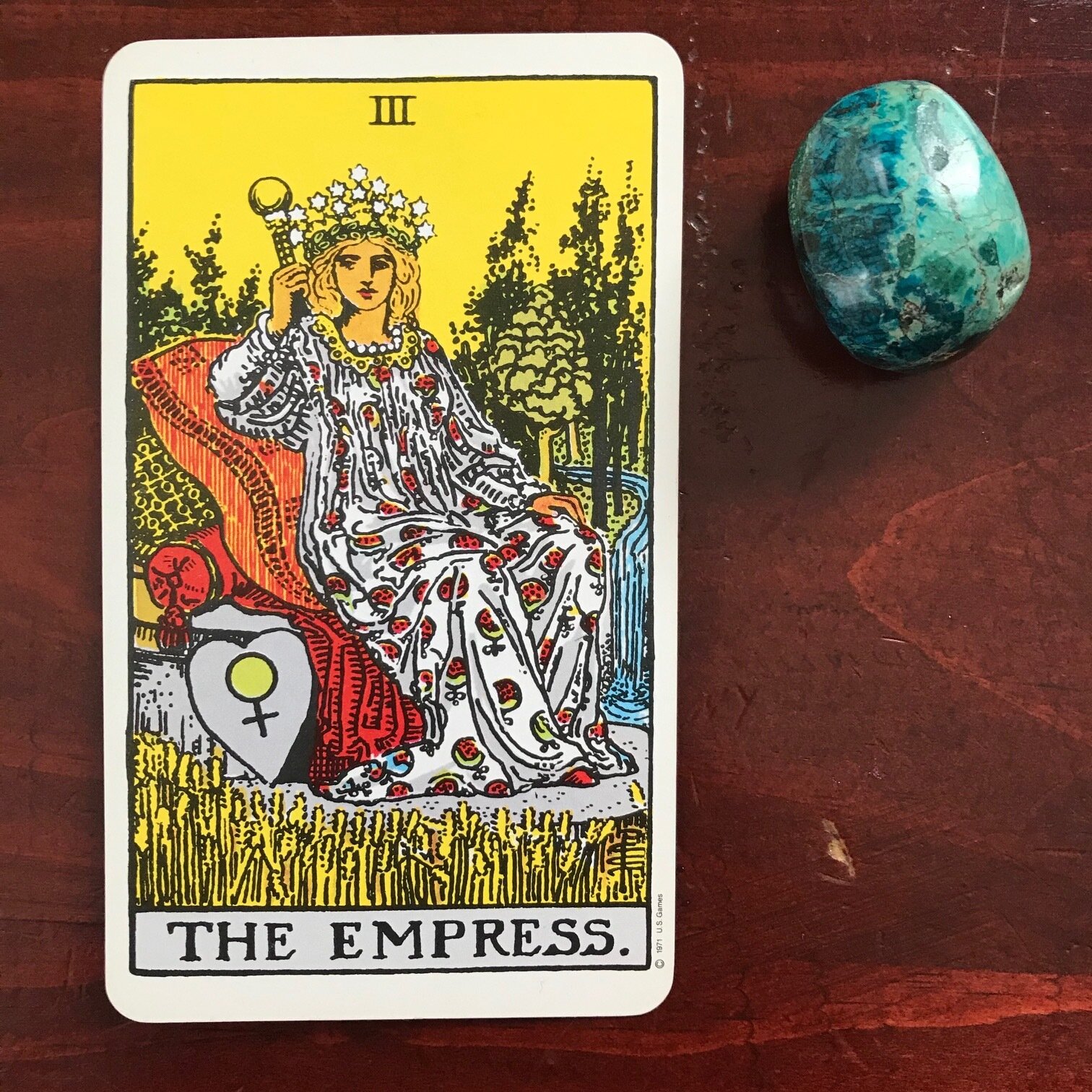
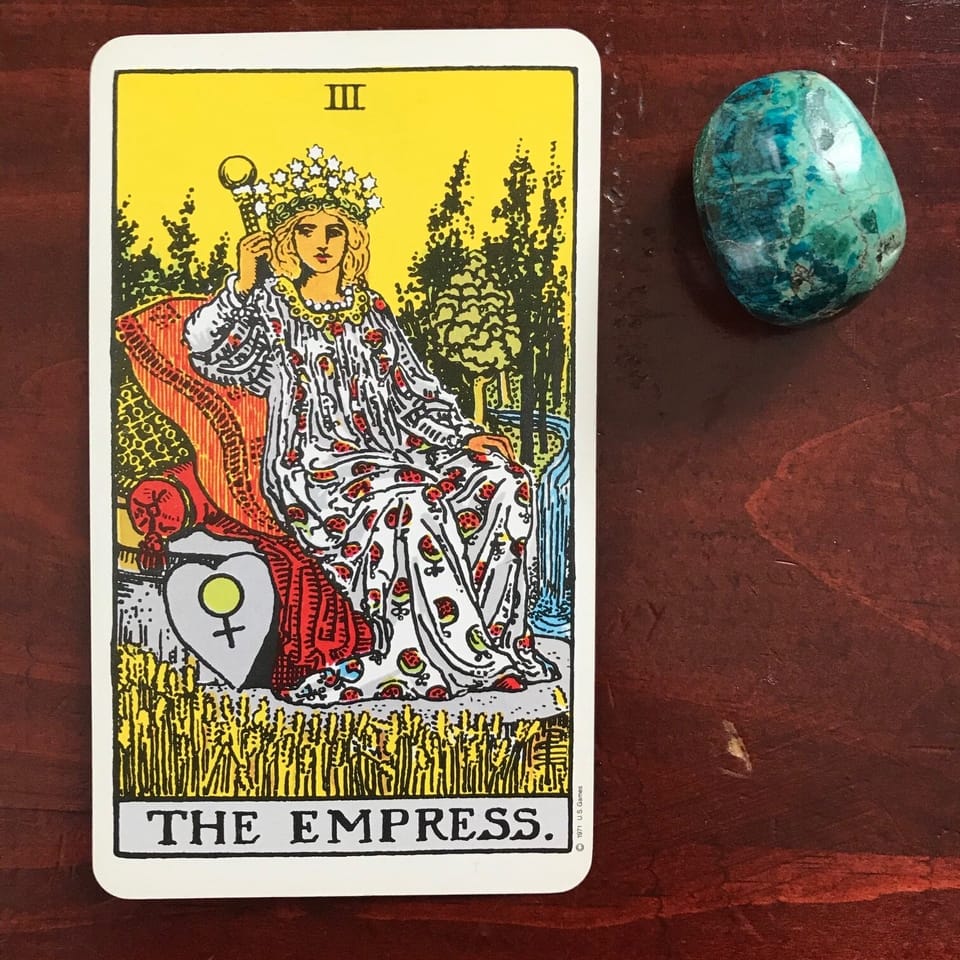
Card of the Month: III The Empress
At the suggestion of friends who prefer listening to reading, you can listen to this month’s offering—it’s a long one!
Here we find a woman at her leisure. She may be sitting on a rock, but she’s made sure it’s cozy with lush pillows and thick, velvety blankets. I can’t think of anything more comfortable to wear than her pomegranate-printed mu-mu. Red slippers, because why not? She sits with her knees apart, one hand resting on her thigh, the other holding up what looks suspiciously like a Hitachi Magic Wand. She wears a crown of stars atop her thick hair. Surrounded by cultivated wheat, evergreen and deciduous trees with a river running through them, spilling into a pool behind her. The sky has the golden glow of sunset, or perhaps dawn. Although she doesn’t look like the type to wake up too early.
The Empress is the archetypal mother of the tarot. After the Magician directs a spark into the vast, still waters of the High Priestess, Life with a capital “L” springs into being and cannot be stopped. She is abundance, fecundity, fertility, and creativity without purpose or goal. She is the uncontained, unrestrained creative impulse and life force. Order and hierarchy will come soon enough, in the Emperor and the Hierophant. For now, there is nothing but life in intimate, mutually beneficial relationship with itself.
I made a deep study of this card last year, as spring (and the pandemic) was getting underway. I asked her to impart her teachings to me. I focused on my relationships with the non-human life around me, and with self-love and pleasure. It’s a deep study that has served me well during this time of social isolation, especially as the months drag on into almost a year, as I navigate the trough of winter and spend more time alone, indoors. And as time goes on, The Empress continues to disclose her secrets to me.
Like everything else, tarot is a relationship. I started by studying meanings in books, and just like any relationship, the longer you stay with an archetype and the more you look and remain in conversation, the more they “tell” you. As a friend of mine once said to me, you may think you’re done with The Empress, but she may not be done with you.
Self-love practice is something that’s easy to laugh at, or make light of. Especially within love-and-light white feminist spirituality, it can be an excuse to disengage from or bypass not only the suffering of the world, but one’s own deep pain. And capitalism loves to monetize everything, so self-love becomes a product you buy, or a course you take with someone who “knows” more than you do. It becomes just another way for us to chase our tails and feel like failures. For me, learning to practice self-love has been my biggest challenge and my greatest liberation.
My journey with this practice began after one of my teachers at the monastery left in disgrace after an all-too-common religious-community scandal. I was deeply attached to him and felt abandoned. My next teacher suggested I meditate on Kannon Bodhisattava and do lovingkindness practice. It helped, to some degree. Looking back from this place, I can see that this practice planted seeds, but nothing really took root until I found myself in an Al-Anon meeting room in a Woodstock church, surrounded by strangers and a profound, permeating love that both surprised and deeply comforted me. These people knew nothing about me or my life. And yet I felt like they really saw me in my raw pain.
My sponsor at that time—who seemed to save my life several times a week—would ask me, “How do you feel?” I would answer, “What are you talking about?” I was lost and terrified and raging, but I didn’t actually know what I felt. She told me to start there. I soon realized that I was thoroughly unpracticed in registering my feelings states—positive or negative. Knowing what I feel is often still a mystery. I think the speed of the overculture makes it challenging to slow down enough to know what we’re feeling. Sometimes it’s not until something from the “outside” clues me in—everyone is annoying me, I pick a fight, I bang my knee for the 10th time that day—that I stop to ask myself: how are you feeling right now?
Why was it so important to know what I was feeling, anyway? Because unless I knew what I was feeling, I couldn’t know what I needed. And if I didn’t know what I needed, I wouldn’t know how to give that to myself. And it was around this same time that the Mother—call her The Empress, the Divine Feminine, Mother Mary, call Her by any of Her 10,000 names—made Herself known to me. How?
I was desperate, devastated, struggling like I never had. My life was coming apart, and I knew it. I felt profoundly alone. And so I cried out for my Mother. And much to my surprise and relief, She was there. She was everywhere. And she cared. She was interested in my pain and wanted to help me with it. I began talking to Her. A lot. Out loud, in my journal, in my head. I began listening to Her, as I made art, as I struggled to meditate. And this worked out well, because now I understood who my Higher Power was in my Al-Anon program.
I remember talking to one of the monastics about this, and he said to me, “but that’s just you.” And I said, “Okay, but putting Her ‘outside’ of myself lets me have a relationship with Her. It’s more helpful for me.” I didn’t realize how much I truly needed a power greater than myself until I found Her.
And for me, this helped me stop doing something I’d been doing all my life: expecting other people to be my Higher Power. My Mother. And this is a good place to say: my own biological mother—alive and well; Hi, Mom!—is a powerful, whip-smart, amazing person. From her I get my political orientations, my filthy mouth and my sense of humor. She is my biggest fan, an excellent sounding board and a hilarious person. And: she’s a human being. There are some things no human being can take care of for us, even our small-m mothers.
In a culture that thrills in blaming and shaming mothers for everything—with whole branches of psychology dedicated to digging around in how our mothers ruined our lives, without examining the set-up for failure that the nuclear family and the overculture are—I can’t recommend solidarity with our mothers enough. I understand that can be really hard if our mothers were addicted to alcohol or drugs, or abusive or neglectful, or just ordinary flawed humans without any support. I spent a lot of time in therapy running over the what-happened-to-me-in-childhood ground. It was an important part of my process, and ultimately I didn’t find my healing there.
I’d spent a lot of my life looking for the person who could take care of all of it for me: Are you my Mommy? Are you my Mommy? In my experience, that hasn’t gone so well. But finding my True Mother, the Great Mother, that’s been going pretty well. The Empress as a powerful archetype is a place where I’ve learned a lot about mothers, mothering and the Great Mother. Here are some lessons that she has taught me:
1. Being Mother & Child at the same time. In order to love myself well, I have to learn not only how to “mother” myself (see Mary Ainsworth via Bethany Saltman), but also how to be a child. Sometimes even an infant. I’ve had to learn how to let myself have my raw, unfiltered feelings, with no rationalizing or explanations. (And I recommend doing this in a place where you feel safe, without others around.) No small thing! I can’t always do it. But how can I respond to signals that I don’t send or let myself have? How can I give myself care if I won’t allow myself the vulnerability to say to myself: I’m hurting. I’m scared. I’m needy. I’m lonely. I’m tired. I’m angry.
So self-love to me is a lot about learning how to be the mother and child at the same time. I have my own ways of doing this—speaking in different voices, different ways of moving my body. Things that if someone were watching from the outside might cause them to say: that person is crazy. M’kay! You know what else is “crazy”? The government abandoning its citizens during a global pandemic so that the ultra-wealthy can continue to profit off of people’s suffering and plunder the planet. So…I’m feeling more and more comfortable with my own personal brand of “crazy” these days.
2. Devotion. If I had a nickel for everytime I’ve been called melodramatic, well… These days, I see all of my passionate energy a lot differently. Part of that has come from observing teenage girls. The culture loves to judge, make fun of, and diminish the power of teenage girls. (Mary was a teenager when the angel Gabriel came to her in the Annunciation. Just sayin’.) In a culture that doesn’t give adolescents of any gender a nourishing, generative place to put all of that rising sap, all of that juice, it’ll get put somewhere. For me, it got directed toward boys, and a distorted sexuality that invariably left me feeling bereft and diminished. Others put this wildness elsewhere. Nothing scares me more than a group of teenage boys with their juices flowing.
I call this “misplaced devotion,” and it’s something that I continued doing for decades. I put it on partners and spiritual teachers, and again: what human person can live up to that kind of projection? Let me save you some time: no one. Finding the Mother—The Empress—has given me a reliable place not only to put all of that passionate, erotic energy that the culture loves to cram into a box called sex/romantic partnership, but that is actually nothing other than the life force itself. But the Mother/Empress also gives me a place to renew and refresh my eroticism. It’s like a beautiful, powerful circuit. I can go to Her with all of my longing, agony, excitement, and rage, and She is here for it, ready to fill my stores.
3. Creativity. This is The Empress’s wheelhouse. This is where she operates, where she feels at home. It’s both the source and outcome of her generative enthusiasm. And here I owe a debt of gratitude to Jody Hojin Kimmel, a resident teacher at the monastery; and dear friends and artists Robyn Ikyo Love and Chelsea Green, who were my guides in tapping this wellspring of healing, joy, delight and medicine. Every time I hear someone say, “I’m not an artist,” or worse: “I’m not creative” I think: Yes, you are. Sorry-not-sorry. If it feels true for you, I empathize. And: what is your investment in believing that? Who benefits from your thinking that way?
Art practice was where I began to birth my true self. It is the thing that kept me alive in this incarnation during the very darkest moments of my life. And it is the place where I delight in surprising myself, communing with the “long story of my soul” (thanks to Perdita Finn for that framing), and keeping my anxious mind engaged. There’s no “right” way to enter this powerful and profound portal. I’ve entered through agony and desperation, and more often these days through play and joy. It can be paint on paper and it can also be cooking a meal, arranging things in space, putting on make-up, making memes. If you’re a person who’s super-resistant to creativity, I hear you, and: I hate to break it to you, but every time you get dressed, sign your name, compose an email—are you following where this is going?—anytime you do anything, you are creating. Your very life itself is nothing but a creative process. “Being creative” is just the extent to which we’re willing to consciously participate in that process.
4. Community. The greatest lie the overculture ever told us is that we’re individuals. That we’re alone. Merlin Sheldrake, in his lyrical, mind-blowing book Entangled Life tips us off that we have more bacteria in our gut than there are stars in the sky. Which means that for literally trillions of actual living beings, our body is a whole universe. But while we’re never actually alone, the experience of loneliness and alienation is profoundly and life-threateningly real. This is why I call the overculture, and racial capitalism in particular, a death cult. It relies for its perpetuation on all of us thinking we’re alone and that we have to make everything happen by ourselves.
Ten thousand years ago, a human being by themselves wouldn’t survive for very long. We are meant to live in community. Our culture in general and the pandemic in particular have made this incredibly difficult. While some people, like me, have found lots of nourishing community in the zoom world, not everyone has access to that or is built that way. We are mammals who need other mammal bodies in space to feel connected and intimate, to feel like we belong.
Community is also where we have a chance (sometimes welcome, often not) to see what we can’t see about ourselves on our own. As a white person, the overculture makes it nearly impossible for me to see the way white supremacy dehumanizes me. No amount of time spent on a meditation cushion or reading a book is going to help me see that. Only messy relationships in community with peers, colleagues and comrades—including ruptures and repairs—are going to do that. And our shadows—the parts of us that are by definition not visible to us—are rarely going suddenly become visible in isolation. It’s only in our reactions to others, and others’ reactions to us, that we have a chance to see who else we are, outside of our heavily managed self-definitions.
I had a tarot reading recently with Sophie Strand (highly recommend!), and The Empress showed up. I am always happy to see her in a reading. Sophie had a fresh take on The Empress that I loved: care without work. The way one candle lights another without diminishing its own light. When we are lit up, when our cup is full, the very activity of our life itself becomes nourishing for ourselves and others. Which brings me to:
5. What do you want? In my Way of the Rose prayer community, we pray together for our heart’s desire. Sounds nice, right? We engage 54-day Novenas where we formulate a petition to Our Lady, the Great Mother, anything you want to call Her, for our heart’s desire. Two moon cycles. We spent the first 27-days petitioning, and the second 27-days of the novena expressing gratitude for having our petition answered, whether it was (or we think it was) answered or not.
As someone who spent four years doing koan study in the zen buddhist tradition, I can tell you with blistering honesty that I have never worked on a koan as challenging and generative as: What is your heart’s desire? I’ve learned a lot in my past training about letting go, about intention. But asking myself what I most deeply want for myself? It’s a profound and life-altering question. A question that systems of domination and oppression depend on our never, ever asking.
Sitting in a (virtual) circle with others, saying our petitions out loud? It’s not incidental. It’s an essential ingredient in the process. Like fungal hyphae reaching out toward nourishment, we speak our petitions, we hear others’ petitions, these desires of the heart weave together and begin to feed and influence each other. And what happens? Miracles. A repaired car. An intergenerational wound healed. A paint brush picked up. A meeting of one’s soul mate. A clean house. A vaccine appointment. A reunion. Confidence restored. Magic.
And if you’re thinking that this sounds like some love-and-light, power-of-positive-thinking, law-of-attraction spiritual bypassing bullshit, I’ll just say this: praying the rosary means praying the Joyful Mysteries one day, the Sorrowful Mysteries the next day, and the Glorious Mysteries the third day—rinse, repeat. Every third day is a walk through the Sorrowful Mysteries—the tragedy of Empire, the tragedy of thinking that Empire can ever be reformed, sitting at the base of the cross bearing witness to climate collapse, white nationalism, patriarchal violence, late-stage capitalism, nearly half a million dead of COVID-19 in the US in less than a year, a government arguing over whether to give us $1,400 or $2,000 while people line up for miles at food banks and freeze to death in homeless encampments all over the country and the stock market reaches new heights. It’s letting the sword pierce your heart. Thoroughly. With our hand in Hers, our hands in each others’ (sometimes virtual) hands.
And remembering that the Glorious Mysteries are coming—the mysteries of disorientation, imagination, of seeing through the frame of the overculture, seeing what lies beyond that broken frame. Magic, mystery, wonder, the long story of Life.
Find out more about my tarot work.