June 2021: This Sacred World
Listen to this month’s offering as a podcast
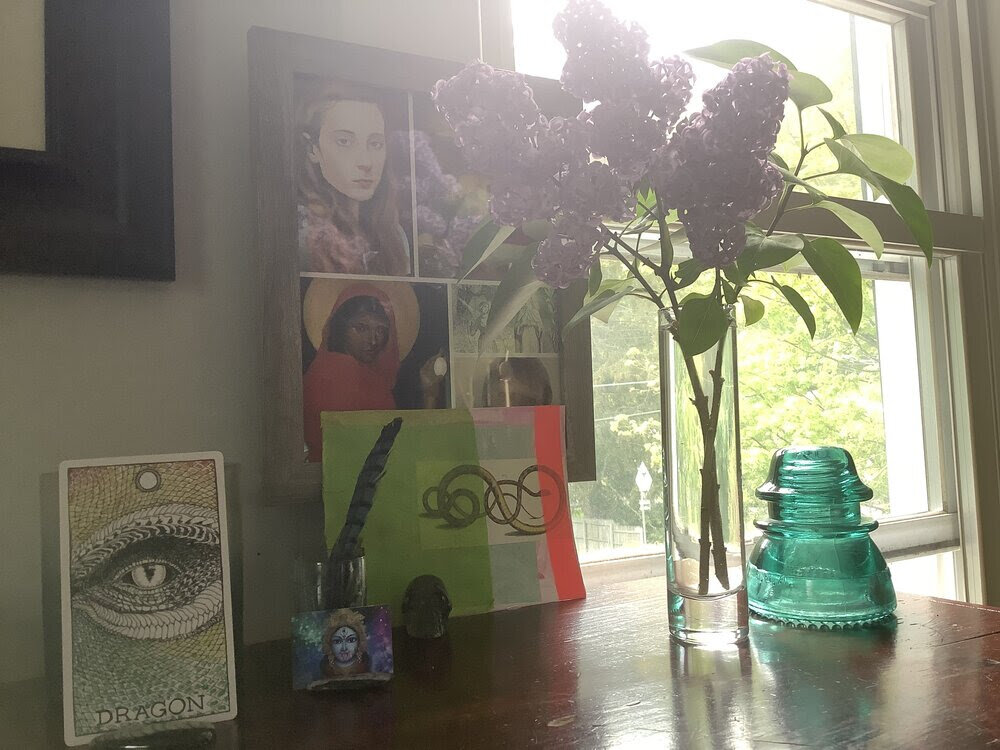
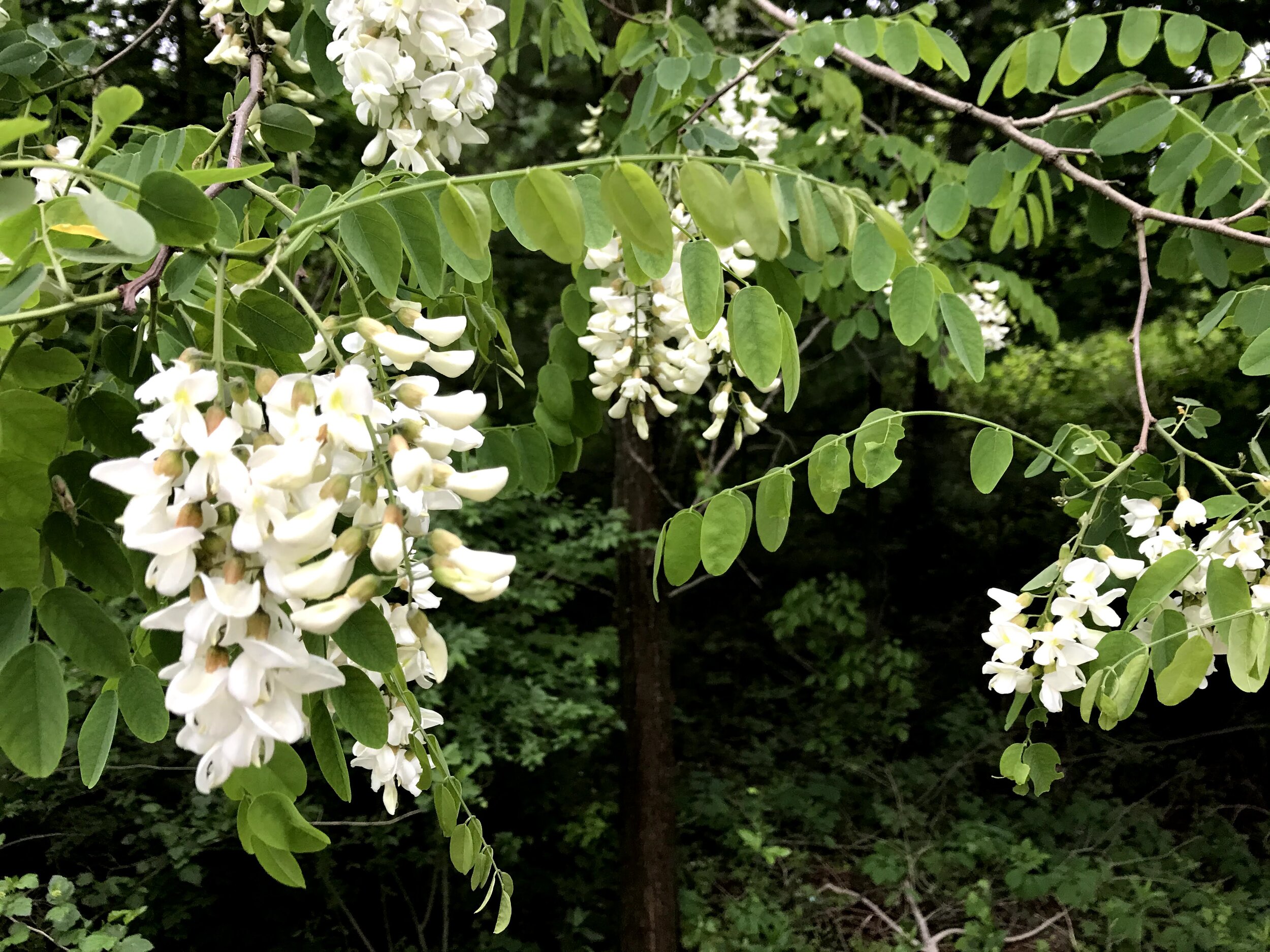
As I write this, the lilacs have had their moment, and the black locust trees are in bloom, their abundant white blossoms perfuming my little corner of the Catskills. The peony buds are getting fat and sticky and crawling with ants. I’ve been blessed with regular sightings of a family of eagles on my morning walks up Route 214, and a yearling bear is tromping through everyone’s backyards, a little bald patch on his behind. I wonder how the season is unfolding for you?
My inaugural 5-week Tarot + Moon workshop was a delicious ride! (Yes, I do say so myself!) Some feedback from the folks who were in the inaugural cohort:
I would recommend this workshop for anyone who wants to:
- deepen into the rhythms of the moon cycle, begin a relationship with tarot, and learn what it means to trust yourself
- enter into a relationship with Tarot that is highly personal and accessible; the radical ease approach—"only do it if you feel like it"—was revolutionary in and of itself
- change your perspective on what is possible with the cards. They are fascinating tools to help us get beyond our ordinary patterns of thinking so we can see things freshly.
The next session begins with the new moon (+ eclipse: yikes!) on June 10th, five Thursdays 5-6:30pm. There are also sessions scheduled in July + August on different days/times.
I’m also offering a new Tarot 101 class on Sunday, June 27th 4-5:30pm for those who want to get their feet wet before diving into something deeper. I’ll record the session and send it out to folks who register who can’t make it at the scheduled time.
Finally, I want to let you know about an intensive that my friend Perdita Finn is offering that I took back in March and that was an absolute life-changer for me: Mothers of Mystery & Magic. A taste: “Patriarchy with its one totalitarian god of abstraction in the sky has waged an insidious war against the mother so that we live in a world where pornographic violence is ubiquitous and breastfeeding is an obscenity, where motherhood is sentimentalized and marginalized, where every gesture of mothering is questioned, criticized, and exploited. Yet, addicted to one substance or another, what we crave most, what we yearn for from the bottom of our being, is to feel the loving and protective embrace of mothers all around us.” Amen. It starts on June 4th + she records the sessions. Do not miss this!
To all of you who continue to support my work in so many amazing and generous ways—THANK YOU.
In love + solidarity + collective imagining,
Shea in the Catskills
What’s Inspiring Me Now
- Dancing with the Birds on Netflix. Heeyyyyy, Mr. MacGregor Bowerbird? I AM HERE FOR YOU.
- This song by The Bengsons has had me so deep in my feelings that I’ve basically been using it for all sorts of grieving that needs to happen. What a blessing to have something that can stir the tears right out of your eyeballs.
- Keeanga-Yamahtta Taylor’s piece in the New Yorker about Mariame Kaba and the prison abolition movement. “Kaba and others in this emergent movement fervently believe in the capacity of people to change in changed conditions. That is the optimism at the heart of the abolitionist project.”
- Sophie Strand has written so many scalp-tingling, heart-thundering and mind-blowing pieces in the last month that it’s hard to pick just one. But I will—Storytelling is an Emergency: An Ecological Reading of Scheherazade. And: go read all of her amazing things.
- Kelly-Ann Maddox’s newly published Rebel Witch: Carve the Craft That’s Yours Alone. A friend recently asked me for a book recommendation for his niece, who is turning 16. He asked, “What is the book you wish you received on your 16th birthday?” This is the book. It has done SO. MUCH. to inform my practice since leaving the Monastery.
- In keeping with my post-apocalyptic reading: Into the Forest by Jean Hegland. Published in 1998, Hegland’s novel is equal parts piercingly beautiful and harrowingly, terrifyingly prescient. It broke my heart a hundred times.
- Thank you to Miriam for sending this incredible article my way about the Southeast Asian Myths and Stories (SEAMS) Tarot project. “We…want to promote the view that tarot could be used in many ways other than as a fortune-telling tool. For instance—in this case, it could retell the well-known tales from various Southeast Asian nations, just like an educational tool.” Tarot is endlessly and profoundly potent!
- My organizing home Showing Up for Racial Justice (SURJ) has been offering some amazing political education webinars. Last month they raised over $50,000 for the Earthseed Land Collective through their White Supremacy Characteristics: 20 Year Anniversary webinar. (If you watch this webinar, please make a donation to the Earthseed Land Collective.) Also check out Tema Okun’s new website re: White Supremacy Culture—an incredible resource. Other recent SURJ webinars: Palestinian Liberation is a Racial Justice Issue and White People Recommitting to Racial Justice. AND: Join SURJ (and me!) for their June 10th Action Zap!
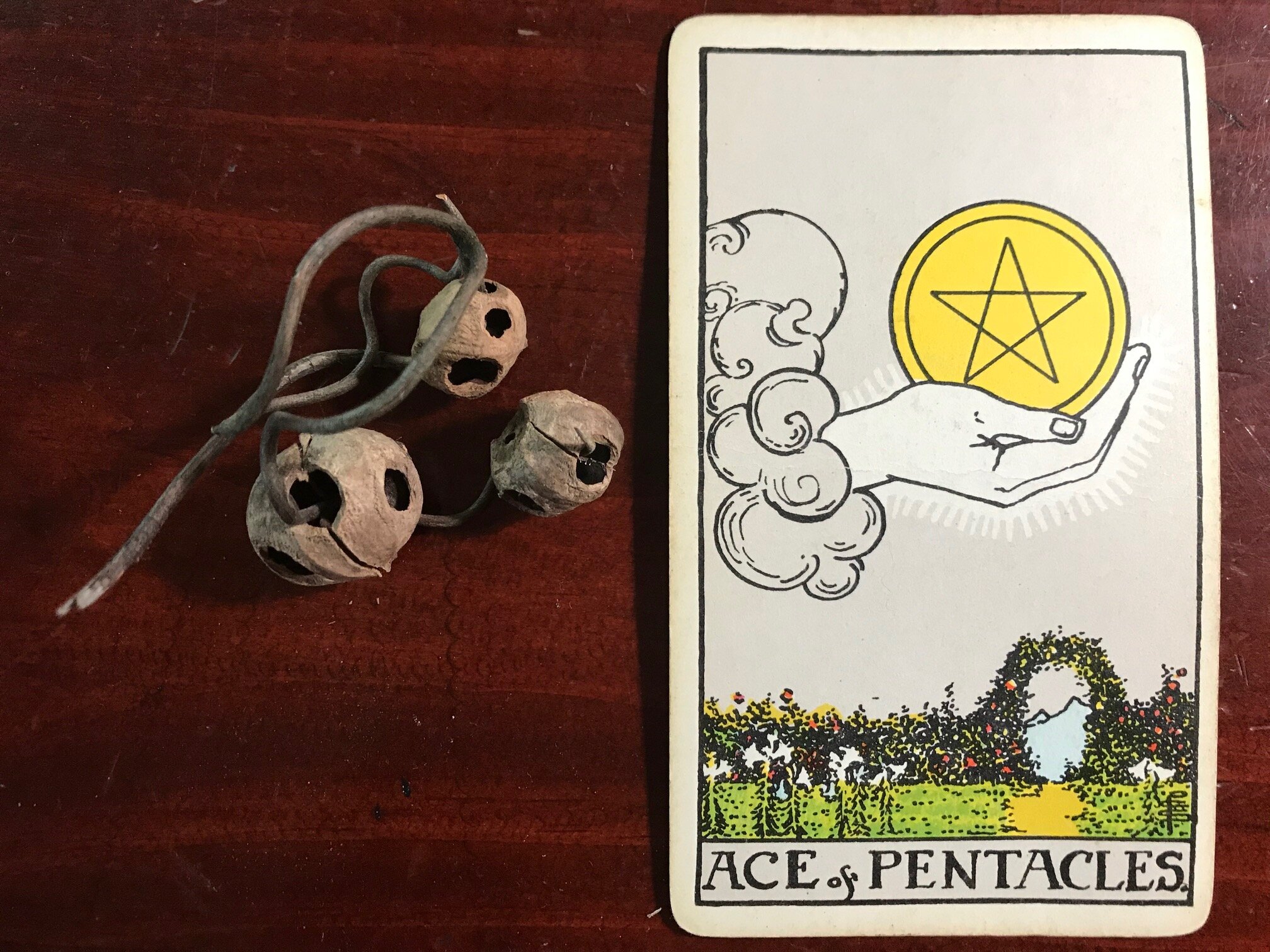
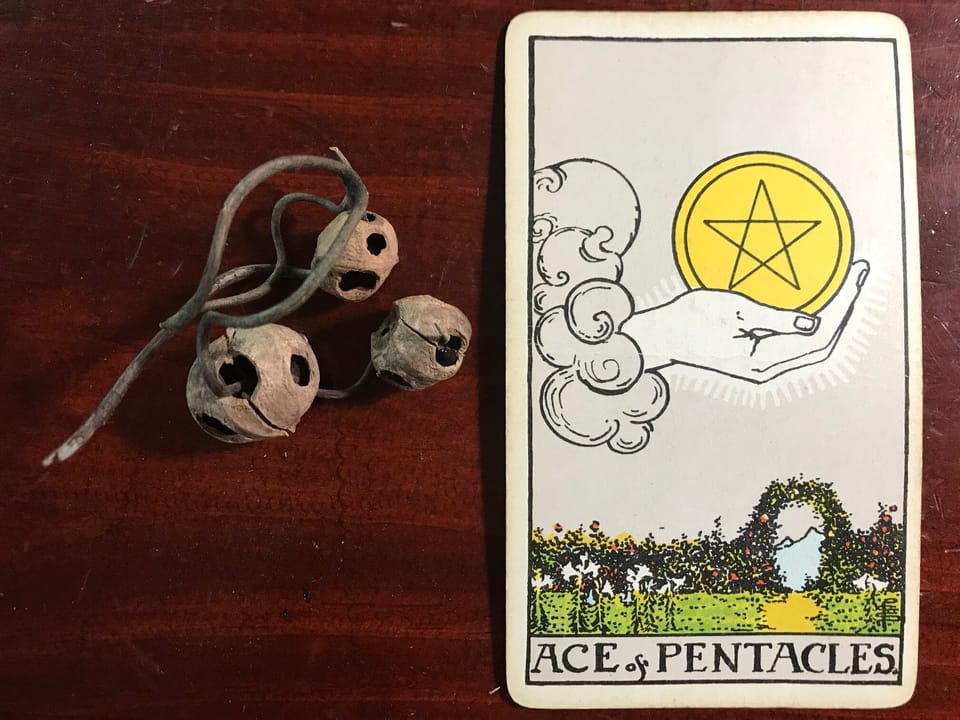
Card of the Month: Ace of Pentacles
In the Minor Arcana (or “little mysteries”) of the Tarot, Aces are considered gifts. In the Ace of Pentacles, a disembodied hand emerges from a cloud holding out a giant golden pentacle. The hand seems to be glowing, or emanating light, or maybe vibrating. The sky is pale gray and clear. At the base of the card is a garden of tall white lilies and a flower-garlanded fence and trellis, through which two pale blue distant mountain peaks are visible.
Pentacles are talismans, often inscribed on other objects, thought to have powers of magical invocation, the possibility to manifest something in physical form. In the Tarot, they are the Earth element. In typical tarot interpretations, pentacles tend to get associated with money, work, career, home and family. In decks of regular playing cards, pentacles became the suit of diamonds.
I’ve been thinking a lot about the pentacles. Because they show up in readings, of course, and so I get to talk about them a lot. And I’m also using some cards in this suit to frame a conversation we’re having in a series I do with my friend Robyn Love called Let’s Talk About It!: Money. In a recent conversation I had about this series with my tarot mentor, Sento, he drew my attention to the Ace, and it’s been on my mind ever since. Whenever I see the Ace of Pentacles, I think about seeds, and planting seeds.
I think this image invites us anew into a relationship of sacredness and devotion with the material world. Pentacles are the Earth element—the literal Earth, made up of every creature, living thing and person that has ever lived and died; our bodies and all the trillions of bodies in them; the whole phenomenal universe of everything that we can see, smell, taste and touch. And the Pentacles are about resources, internal and external: time, space, money, relationships, as well as worth, abundance, resilience, groundedness, safety, security and stability. Or the lack thereof.
How do we have a relationship of sacredness and devotion with the material world inside an overculture built on the theft and exploitation of land, labor and life force—historical and ongoing? An overculture that tells us that “time is money” and that things (and we!) have a “shelf life?” That tells us who and what counts, who gets to count, and how to count everything? That tells us you better get yours and quick, before it’s all gone (toilet paper in 2020 anyone?)? That does its utmost to convince us that those who have the most money are the happiest and the best kind of people? That tells us that poor people are unlucky at best and morally deviant and lazy at worst?
If we are looking to the overculture for any measure of worth—our own or anything else’s—we are situating ourselves in a never-ending stream of self-doubt, fear, shame and insecurity. We will be using a lens that desecrates all that is life-giving and generative and connective in favor of a deadly and toxic story of individualism, alienation and isolation. So we might consider not looking to the overculture for worth—our own, or anything else’s.
So where do we look? What do time and money and work look like outside of the overcultural frame? Is it possible to even look outside of that frame? For a long time, I believed that money was evil and that people who had a lot of it were bad. I will say that I stand by the belief that in a world where people are hungry, without housing, healthcare and safety, being a billionaire is inherently immoral. Where do I draw the line short of that? I don’t know. Better to not go around drawing lines, probably. Shit’s complex, and whenever I start lumping things into good and evil, and drawing lines between this and that, there is probably something stirring in my shadowy parts that could use a look-see.
Since leaving the Monastery, where I earned no income for 10 years, my relationship to money continues to evolve, trouble and deepen. In her book The Energy of Money: A Spiritual Guide to Financial and Personal Fulfillment, Maria Nemeth identifies six primary forms of energy: money, time, physical vitality, enjoyment, creativity and support of friends. She also quotes Joseph Campbell: “Money is congealed energy, and releasing it releases life’s possibilities.” I am curious about money, what it is, what it can do, and why it makes us feel so many different ways. Some of the most potent, generative, and activating conversations I’ve had in the last couple months have been about money.
As a woman and femme, I am deeply conditioned to devalue my own work. So much of the work that women do in the culture is literally devalued—childcare, eldercare, meal preparation, housekeeping and household maintenance, coordinating family schedules and appointments. Care work is so devalued that even when it is paid, it’s for a fraction of what might constitute a living wage. Spiritual and creative work—two forms of work that I regularly engage in—are also devalued in the culture. If it’s spiritual, or something that I deeply enjoy, should I be getting paid for it?
And goddess forbid we should talk about it! In our first session of Let’s Talk About It!: Money, we told our financial autobiographies, using real dollar amounts. For many, it was the first time they had ever spoken these things aloud. Eyes popped as the stories unfolded: stories of reversals of fortune in both directions, stories of confusing and mixed messages from family, stories of performing class in one direction or another. Most every story contained one common theme: silence. As much stress and anxiety as money (or a lack of it) caused, families never talked about it. I’ll speak for myself: underneath the exhilaration that accompanied listening to these stories was a thread of shame. It’s not even something that I can explain to you, it’s just something that was definitely present for me.
In my electoral work with SURJ last year, storytelling was a major part of the leader team’s training and work together. At some point during every action, someone did a fundraising ask, and would tell a story about their relationship to money. SURJ offered workshops for us about financial storytelling, and I learned quite a bit there about how the overculture is designed to keep us silent and ashamed and judgmental of each other when it comes to money. What would happen if we actually started to talk about it? You can be sure the ultra-wealthy are talking about money all the time. You can be sure they are networking and circulating their wealth to support policies that allow them to hoard more of it at the expense of the rest of us.
Mutual aid is a model of resource redistribution that those living on the margins have been using forever. Knowing that the state not only won’t do anything to support their having what they need to survive and thrive, but will actively undermine their safety and sustenance at every opportunity, folks create networks to meet each others’ immediate survival needs. Mutual aid also includes doing the political education necessary to make clear how systems are set up to perpetuate precarity for the most marginalized. And as climate change creates increasing conditions of precarity, mutual aid is something we’d all benefit from knowing more about.
One way that the overculture keeps us from being able to see outside of its frame is through busy-ness. The hustle that most people need to do to be able to provide for their housing, healthcare, childcare and other basic needs can leave them with little time or life-force energy to wonder, to dream and imagine. What if our most basic needs were met? What else would become possible?
There’s a belief that if people’s basic needs for food, housing and healthcare were met, they wouldn’t want to work. And I say to that: amen and blessed be. There is more to life than work-for-pay, and I for one am curious to know what kinds of work people might get up to if they weren’t worried about paying their grocery bill. What kind of art would they make? What kind of study and divination and healing modalities would they be drawn to, and how would that benefit their communities? What community projects would people cook up with each other to feed and heal and sustain their families, friends and neighbors?
As my friend Perdita Finn wrote: “Underlying modern life is a radical anxiety about what we all know is coming.” How are we being kept so busy paying the bills that we don’t have the time, energy and other resources to develop the relational and material skills to meet what we all know is coming? When the next pandemic descends like a wildfire, when the actual wildfires start burning again, when the rivers flood and the internet goes down for weeks at a time, do we know how to reach for each others’ hands? Do we know how to feed each other and get fed? How to keep each other warm and safe?
For whatever reason, my curiosity and questions about money—and the gift of the conversations I’m having with others about it—feel like a kind of preparation. How do we encourage transparency and authenticity? How do we meet each others’ whole humanity when shame and judgment are ricocheting in our minds? How do we ask questions that invite more possibilities? How do we hold each others’ hands through a conversation intended to make us feel sick, frozen and ashamed? How do we begin to see every single relational moment, material “object,” and form of energy as a sacred, magical, creative medium?
I don’t know, and I want to know. The Ace of Pentacles shows me an image of possibility. Of considering the gifts that are being offered to me all the time: hot water out of the tap, the iris and peony buds heralding the beginning of summer, a delicious treat from my housemate, a troubling question from a friend that invites me to look more closely, the peepers’ song, Her hand in mine at every moment.
The image also invites me to consider that I am never not offering something. What is it, then, that I am bringing into the world—in my thoughts, speech, actions and relationships? What seeds am I planting? What am I growing and nourishing? How am I shaping and being shaped by the world? What world do I want to live in?
Find out more about my tarot work.