March 2021: Embracing Complexity
[caption id align="alignnone" width="2500"]
At the suggestion of friends who prefer listening to reading, you can now listen to this month’s offering.
What’s Inspiring Me Now
- The latest episode of Robyn Love’s Small Things Brought Together—this time with Jody Hojin Kimmel—I watched it twice!
- The Radio Garden app. Thank you Mary B for this incredible world-traveling journey through radio. I love RTÉ Raidió na Gaeltachta out of Galway, Ireland for when I want to steep in the Irish language. Late Saturday night studio explorations go well with the single human voice channeling the Divine on Radio Oran FM 92.7 out of Oran, Algeria. If you find good local music from around the world, please send it my way!
- Speaking of Ireland, thank you Bryan for sending me a link to a zoom talk with Manchán Magan about his book Thirty-Two Words for Field: Lost words of the Irish landscape. I ended up ordering it directly from Magan (it’s not yet available in the US), and it is a magical, wonderful book. Here’s teeny taste, with instructions for ordering in the image caption.
- And speaking of magical books, thank you Perdita for turning me on to Sand Talk: How Indigenous Thinking Can Save the World by Tyson Yunkaporta. My experience of reading this book was of yelling “omg!” and underlining everything. It’s a book that has changed my thinking on many issues I’ve felt sure about for years. (I think that’s a good thing!) If you want a taster, here’s a podcast episode with Yunkaporta that was similarly and deliciously noodle-twisting.
- Witches and Pagans: Women in European Folk Religion, 700-1100 by Max Dashu. Just started, but if this doesn’t get your juices flowing… In referring to the primeval triple Maidens known as Norns, Dashu writes: “…the Norns’ names have very deep Indo-European roots. They go back to a distant proto-Indo-European root Wert…meaning ‘to turn, revolve, spin, move in a circle.’ In some European daughter languages, this taproot concept evolved into a verb of being and becoming. This complex of meanings gave rise in turn to Germanic names for a Fate goddess who personified causation, change, and movement through time. The Norse knew her as Urðr, the Germans as Wurt, and the Old Saxons called her Wurð. In Old English her name was Wyrd or Werd, giving rise to the medieval word for destiny: weird.” Emphasis totally mine—I mean!
- And speaking of Max Dashu, check out the Suppressed History Archives!
What’s Inspiring You Now
- Thank you Gabe for this link to The Revolutionary Practice of Black Feminisms: “In 1864, Sojourner Truth sold cartes-de-visite, small photographs mounted to a paper card, to support her activism. Featuring the slogan ‘I sell the shadow to support the substance,’ Truth capitalized on the popularity of these collector’s items to support herself and fund her speaking tours.”
- Thank you Bethia for this delicious meander into storytelling and textiles in Botanical Colors’ Feedback Friday video with Jordana Munk Martin, founder of the TATTER Library. (I recommend starting 11:30 in, as there were some technical glitches at the front end of the video.)
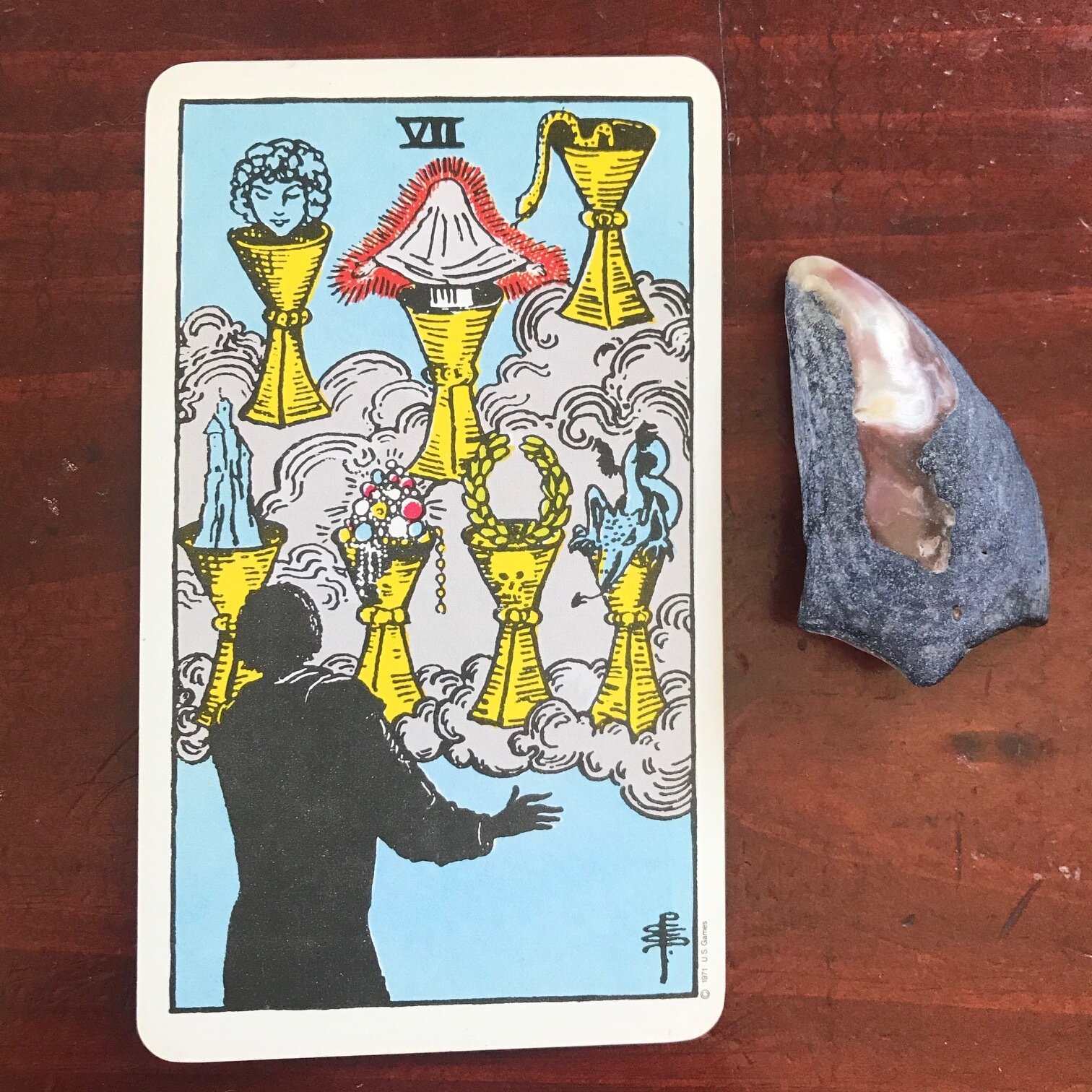
Card of the Month: 7 of Cups
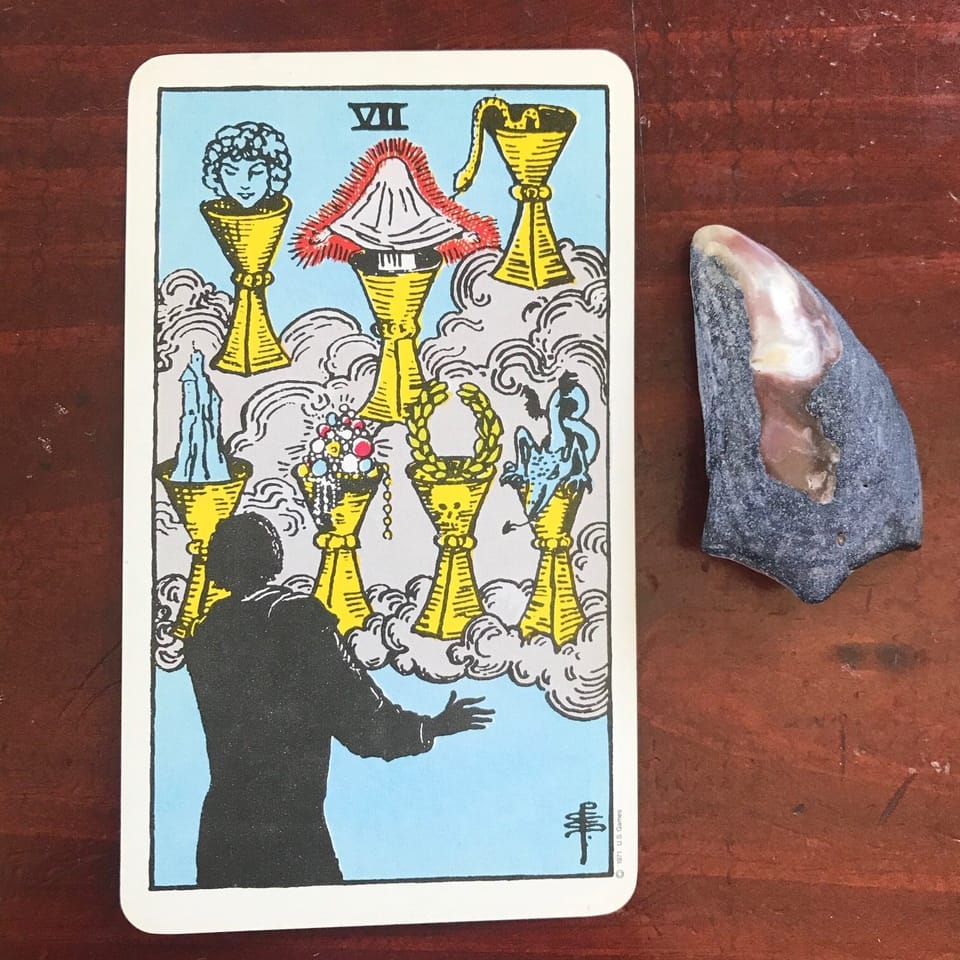
This is a card about complexity. We can see in the imagery: a billowing cloud on which perch seven golden chalices, filled with all manner of...stuff. In a contemporary deck, this card might show us an Instagram feed, with posts by intimate friends mixed in with those of relative strangers mixed in with advertisements that “mysteriously” align with our desires. The figure in the foreground with their back to us looks startled, in a posture of “wtf!?!?”
Before we rush in to figure out “what’s going on” here, let’s just pause for a moment to take in the overwhelm, the confusion, the what-the-fuck nature of the moment. Witch and tarot reader Sarah Faith Gottesdiener says the sevens in the tarot minors concern a moment of sacred pause prior to transformation and evolution. Witch and reader Amanda Yates Garcia sees tarot sevens as initiations after the return-to-harmony of the six, before the mastery of the eight.
The overculture conditions us to have all the answers, figure things out and know what’s going on. We get rewarded for this behavior with high test scores, admiration, authority. But in the watery realm of the suit of Cups, something gets lost: moments of disorientation that can serve as potent portals into the mysteries of our imagination, and to evolving beyond our current limitations. This card is an invitation to feel into emotional and imaginal complexity.
The suit of Cups is the realm of emotions, relationships, dreams, intuition, desire, vision, creativity, nurturance and our connection to Source, however we might define that. The cup in the Ace of Cups is literally the Holy Grail—our life’s purpose, the thing we return to to restore ourselves, our deepest reasons, our soul’s journey. As we travel through the suit of cups, we connect, feel felt, withdraw into ourselves, grieve losses, and return to a basic equilibrium of simple kindness. We get to the seven, and things become less simplistic. More complex. Thicker. We’re presented with a whole bunch of choices: what do we actually want? How do we know?
While different tarot readers have their own takes on the symbols contained in the cups, I always appreciate the invitation to make my own associations, and to let these change and evolve with my current circumstances. I invite you to do the same.
In the bottom row, we see a castle atop a mountain. Is this a fortress? A fairy tale? An ancient place? The home of a sovereign? Then we have a cup overflowing with a whole heap of jewels: Bling. Shiny things. Eye candy. That Instagram ad that shows us exactly what would scratch that momentary itch...for...something. And also: adornment, beauty, bounty and treasure. Nothing is ever just one thing. Next is a laurel wreath—symbol of victory, achievement, pride and recognition—atop a cup embossed with a skull—symbol of mortality.
Then a dragon. A symbol of enlightenment in Buddhism. From the book Sand Talk: “the romantic European image of the knight slaying the dragon is actually a hidden reference to the systematic genocide of what were called pagan peoples.” Monsters. Inner demons.
In the top row we see a disembodied head. Is this a god? A statue of a VIP? A beautiful goddess? A symbol of our cultural disease of disembodiment? Let’s skip the glowing figure in the middle for a moment, and move to the snake: a symbol of our reptilian brain that helped us evolve and now more often gets us in trouble? A symbol of the goddess? Of magical and divinatory powers? Of change and transformation?
So who is this draped figure in the middle, appearing to glow or vibrate with red light, with aliveness? I think I see a white robe under there. Is it Jesus? Or an angel? A friend? Foe? Me? You? Why are they glowing? Why are their arms spread out like that? And why are they covered?
Lots of questions here. Given the swipeable, scrollable, clickable nature of the culture, it can be hard to stick with questions. Easy to glaze over: next! Or maybe we feel a sense of irritation: what is she talking about? This is too complicated. Whatever. Or we may fall into a wormhole, losing ourselves in a tangent, a red herring, a side issue. All excellent strategies of avoidance, ones I have become intimate with in my own way over these last twelve months of physical distancing and prolonged solitude.
So: which chalice will we choose? Will we choose not to make a choice—its own kind of choice? Who do we listen to to make the “right” choice? The “best” choice? Do we listen to ourselves? Which self? The one that longs to be seen? To be recognized? The one in the grips of their inner demons? The one who is just trying to survive? The one who wants a shiny new thing? Who wants beauty? Who wants to live forever? Who thinks they’re right? The one living in a fantasy?
Do we listen to others? The experts? The sages and gurus? Our friends? Which relationships do we feel accountable to? Who do we trust to help us see what we can’t? When is it right to ignore the advice of others and trust ourselves entirely?
While I think the tarot can be a powerful tool in a particular moment and context, what I love so much about tarot cards is that they don’t provide answers. There’s no final card. There’s always the next moment, and our ability to experience, feel, think and act in order to shape that moment to create the life we want. And this card can be about feeling into what that means: what is the life we want? What do we want it to feel like? Look like? Who and what is in it? Who and what is not? Do we know? While the overculture depends for its continuation on shaping our desires into consumption and accumulation through simplistic stories and messages, we are complex. Our desires are complex. Life is complex.
The seven of cups invites us into the complexity of our imagination and desires, and to be willing to contend with what we find there. It’s okay to be startled, to not know. To have our circuits fry a bit. When we connect with others—in friendship, in family, in community, at work, at play—we may find that our joint complexities produce beautiful patterns we could never see or appreciate on our own. And for inspiration, nature—an old sycamore, a thawing streambed, a mountain shaking off its winter coat, birds and squirrels going about their mysterious business—offers us an example of complexity par excellence. Complexity thrives effortlessly here. And we? We are nature, too.
Find out more about my tarot work.