February 2022: Meeting Each Other
Listen to this month’s offering as a podcast
The Study Tarot Series is starting again at the beginning! Join me + a small group of tarot enthusiasts to take up the Magician + Aces on the second + third Sunday in February. This new section grew out of a recent Tarot 101 class, so if you’re brand new to tarot + curious, this series is the right place for you.
On Saturday, February 26th, Robyn Love will be our guide for Let’s Talk About It: Food + Eating Appetite. I’m so excited for this exploration + hope to see you there!
My books are open for readings this month…
Thank you to all of you who continue to support my work in so many amazing and generous ways.
In love + solidarity + collective imagining,
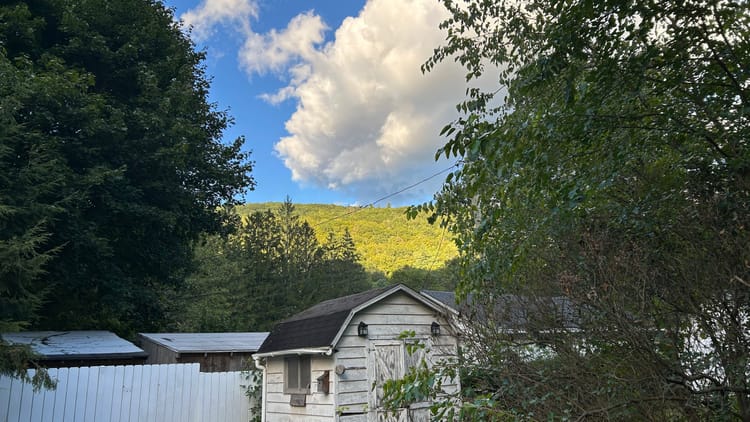
shea in the catskills
You Might Be Interested
- Friends I’m No Longer Friends With—a brand-new podcast by my friend Cheryl that courageously takes up the tender taboo of friend breakups
- My friend Itoro Bassey wrote her first novel: Faith. I loved it so much that I reviewed it
- Robyn Love + I had a juicy, generative convo about creative + spiritual practice, liturgy + desire
- I just finished the Finding Freedom: White Women Taking On Our Own White Supremacy online workshop, and it was really good medicine
It is possible and indeed necessary to open up the imagination and to open up the practices for a world which can yet be but is not yet. And that's a collective task that can't be done just in the effect of work, and critique, and condemnation. That has to be done so as to give each other heart for a world which can still be, even in the grip of the kinds of extreme urgency that I think all of us are feeling very deeply.
—Donna Haraway via For the Wild podcast
What’s Inspiring Me Now
- I think binge-listening to Esther Perel’s two podcasts—How’s Work? and Where Should We Begin?—has been an important part of my Venus retrograde. She is a master of hitting the emotional acupuncture point.
- Greek Myths: A New Retelling by Charlotte Higgins, with illustrations by Chris Ofili. These familiar stories become freshly complex + vivid told through tapestries woven by Athena, Arachne, Helen, Circe, Penelope + other women.
- Tarot and Divination Cards: A Visual Archive by Laetitia Barbier. (Thank you, Jennifer!) “When we shuffle the cards and arrange them into a spread, they become small-scale temporary [art] exhibitions, gracefully curated by serendipity.” A magnificent contribution to the fathomlessness of tarot.
- Rachael Nevin’s essay on wintering: “And how I admire the trees for how they stand stripped bare in the cold all winter long. They make their own shelter.”
- Ayanna Young in conversation with Tricia Hersey of The Nap Ministry. “To sit with your eyes closed for 10 minutes and daydream, that’s rest. To say ‘no more,’ to look at your calendar as a sacred text…”
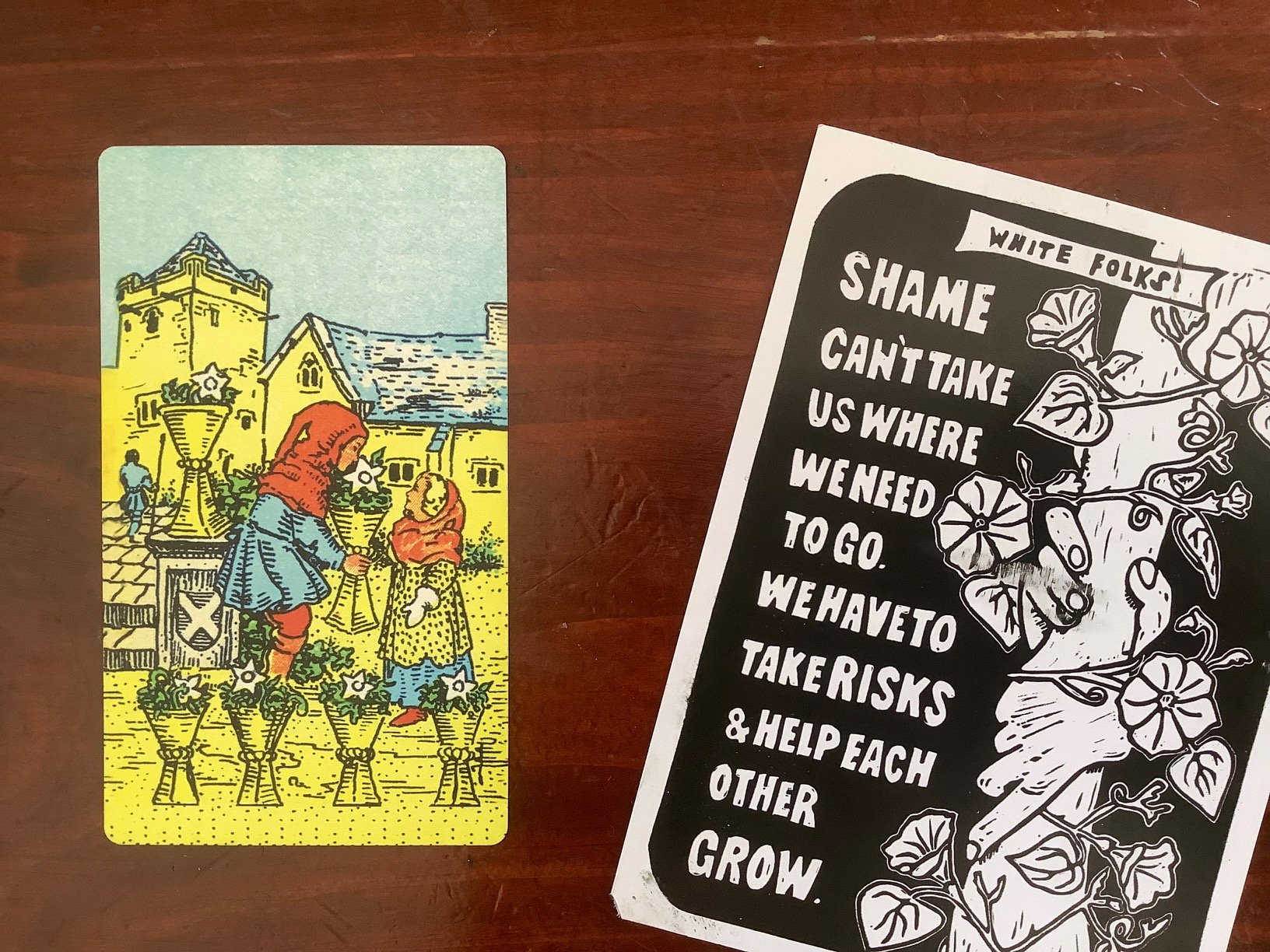
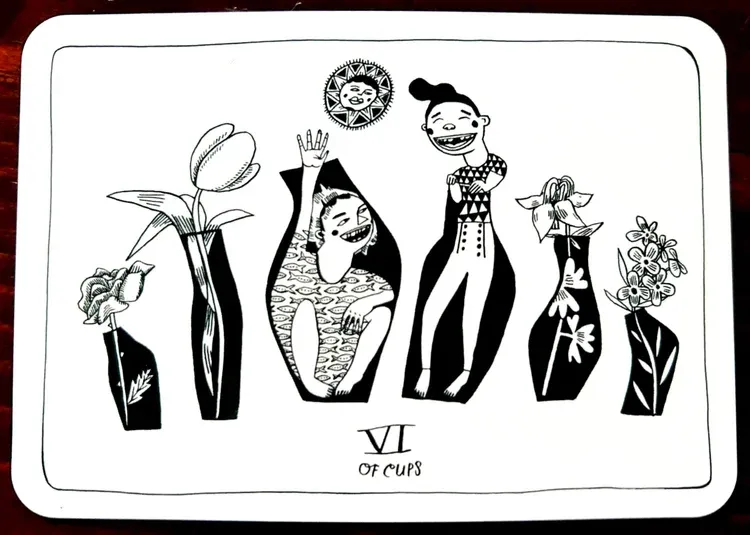
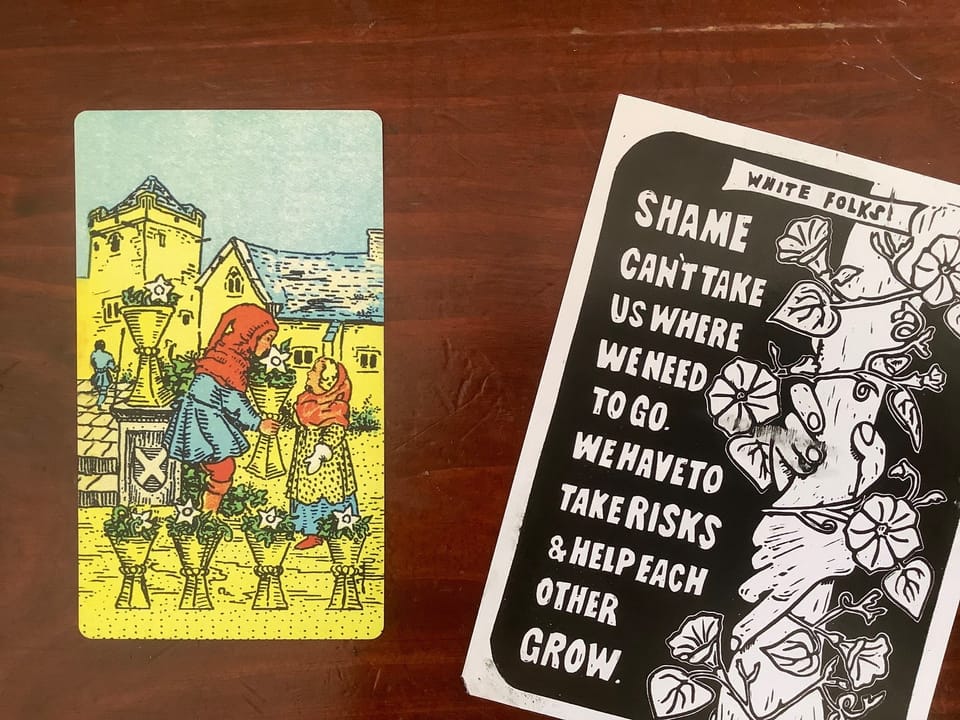
Six of Cups
Sun in Scorpio | emotional underpinnings, vulnerability, emotional mirroring, childlike imagination
I’ve noticed that when I’m in antiracist spaces—particularly majority-white ones—I become familiarly dysregulated. I find myself toggling between hyper-criticality and helplessness. This particular pairing is familiar to me from my years on the meditation cushion: the drill sergeant and the infant. Two sides of one not-very-functional coin.
What this might look like in action is sitting in an online antiracism workshop and wondering why the facilitators are doing things this way instead of that way, followed closely by the tantrum-y feeling that no one is paying attention to me. Again, this toggling didn’t originate in white antiracist spaces, but being in them often exacerbates it. And it happens often enough that sometimes I’m able to observe it with some curiosity.
It showed up in my very first phone bank, when I left the action early because I felt overwhelmed. Logically, I could understand that strangers in Georgia hanging up on me was nothing to take so personally. But my perfectionistic drill sergeant collapsed into an infantile puddle all the same. It took a couple tries before I was able to stay on the phones for a whole action.
This observation has made me curious about my and other white people’s capacity for risk-taking in antiracist work. I mean, maybe I’m the only one who emotionally regresses in white antiracist spaces—losing my voice, or the one doing the shouting; underfunctioning or overfunctioning—but my guess is I’m not. Which brings me to the medicine of the Six of Cups.
Last month, I received some bad news shortly before an action-hour I was supposed to co-facilitate with SURJ. This came in the middle of a difficult week and I could feel myself getting rigid and panicked and feeling pressured. I sent an email to the other folks in the action planning group and essentially said: I will be at this action, I want to be at this action, and this is how I’m arriving: grieving and on the edge of overwhelm.
Everyone in the planning group wrote back with words of comfort and support. The action lead said this: “If you change your mind about facilitating (at any point, even after you start), that's fine and we got you." When I read this, it released something in me, and not only was I able to feel what I was going through more deeply, but I also felt permission to show up for the action as I actually was. It created so much space for me and increased my capacity. It was the medicine of the Six of Cups: You’re not alone. We got you.
As someone who has often felt like I have to show up and do everything perfectly (white supremacy culture + codependency is a hell realm!), having a different experience, particularly in white antiracist spaces, has felt deeply reparative. The extent to which I feel infantilely dysregulated is also the extent to which a positive, supportive intervention feels deeply healing and transformative.
I have been the person in antiracist spaces who simply replicates and reinforces a dysregulating atmosphere, where shaming, blaming and judging shuts everyone down. Seeing this in myself has been both very painful and provides a potent reminder that the way we do anything is the thing itself. Seeing white people in antiracist spaces model other ways of meeting people’s (read: my) vulnerability has helped me practice meeting myself and others with more patience and compassion.
I had a second experience like this just a few days after the first. In the final session of an online workshop for white women, we were sent into breakout rooms to debrief an exercise that I was having trouble tracking while it was happening. I unmuted myself and simply said, “I’m feeling really dysregulated and I’m having trouble tracking what’s going on right now.” A woman in my group asked if it would feel supportive to do a brief co-regulating practice together. I said it absolutely would. She asked, Are you activated and need to get grounded? Or are you frozen and need to come back to life?
So: not only an offer of support, but an actual menu of support to meet me exactly where I was. No one said, “We don’t have time for this,” or “We’re supposed to be…” (things I absolutely would have said not that long ago, sad to say). The Six of Cups says, I see what you’re carrying in this moment, and I’m going to meet you right there. Maybe what you’re carrying is beautiful and nourishing, and meeting you means receiving it fully. Or maybe what you’re carrying is too much for you in this moment and we can all take a piece of it, we can take your hand and bring you along. The Six of Cups says, We won’t leave you behind.
I’m increasingly interested in how to communicate the depth of feeling and freedom I experience in white antiracist spaces. Yes, there’s dysregulation and emotional regression. And in fact, those very feelings + experiences have become signals to me that I am deep inside the shadowy structures that white supremacy creates in white people’s psyches and bodies and hearts.
When it comes to antiracist work, I used to do it to be “good.” Now I do it to be free. It’s a chance to be a whole person—vulnerable, tender, empathetic, sensitive, generous, curious. And it’s a chance to grow capacity and courage to take risks + take action, and to dilate the frame of what I think “action” means or looks like. I find so much life here, so much generative community and connection.
As the pandemic wears on and wears us down, the Six of Cups can be a reminder that we are not always interacting as grown-ups. As I observe adults bicker with each other over trivial things, as I slam on my brakes to get a tailgater off my bumper, I have to remind myself: we are so uncertain, so sad, so scared, and likely feel so dysregulated and unsupported. That feeling of going through it alone is white supremacy culture, too. The Six of Cups says: You are not alone.
Being in community together around our deepest values is a chance to shine a light on our shared cultural shadows and meet each other there—in the place where we feel like we have the least capacity, the most shame—and say, in the words of the Six of Cups: I’m in this with you.
Find out more about my tarot work
Midway upon the journey of our life
I found myself within a forest dark,
For the straightforward pathway had been lost.
—opening lines of Dante’s Inferno