Entering February
Thanks to those of you who came out for last night’s Tarot for Self-Study Workshop—it was a blast!
I hope that winter is treating you well, in all its disconcerting mildness, and that you are soaking up the lengthening daylight.
As always, I’m excited to share this month’s inspirations with you. A really amazing one came in from one of you—please check it out and spread the inspiration.
This issue’s Tarot Card of the Month is a little heavy, especially compared to last month’s. But it’s heavy times we’re living in. Within all of it, let’s keep bending toward the light, in ourselves and with each other.
What’s Inspiring Me Now
- Fantastic Mistakes: Neil Gaiman’s ‘Make Good Art’ Speech. A collaboration with graphic designer Chip Kidd, this transcript of Gaiman’s commencement speech at the University of the Arts in Philadelphia is a quick, beautiful, inspiring read.
- Calling all locals! Olive Free Library’s Student Show: Onteora School District is beautiful. This exhibition of artworks created by high school students of the Onteora School District runs through March 14th.
- The Pleasure Mechanics podcast episode on micropleasures. What we pay attention to grows…
- You Were Born For This: Astrology for Radical Self-Acceptance by Chani Nicholas. For a preview, cast your natal chart on her awesome website. If you end up wanting more, the book is potent medicine.
What’s Inspiring You Now
- Bethia Waterman emailed me about Eunice Newton Foote. She was an amateur scientist from the mid-1800s whose experiments foreshadowed the discovery of Earth's greenhouse effect. Her discoveries were overlooked for more than a century because women were not allowed to present their work to the male science community.
What’s inspiring you now? I would love to hear about it and include it in my next newsletter…
New in the Shop
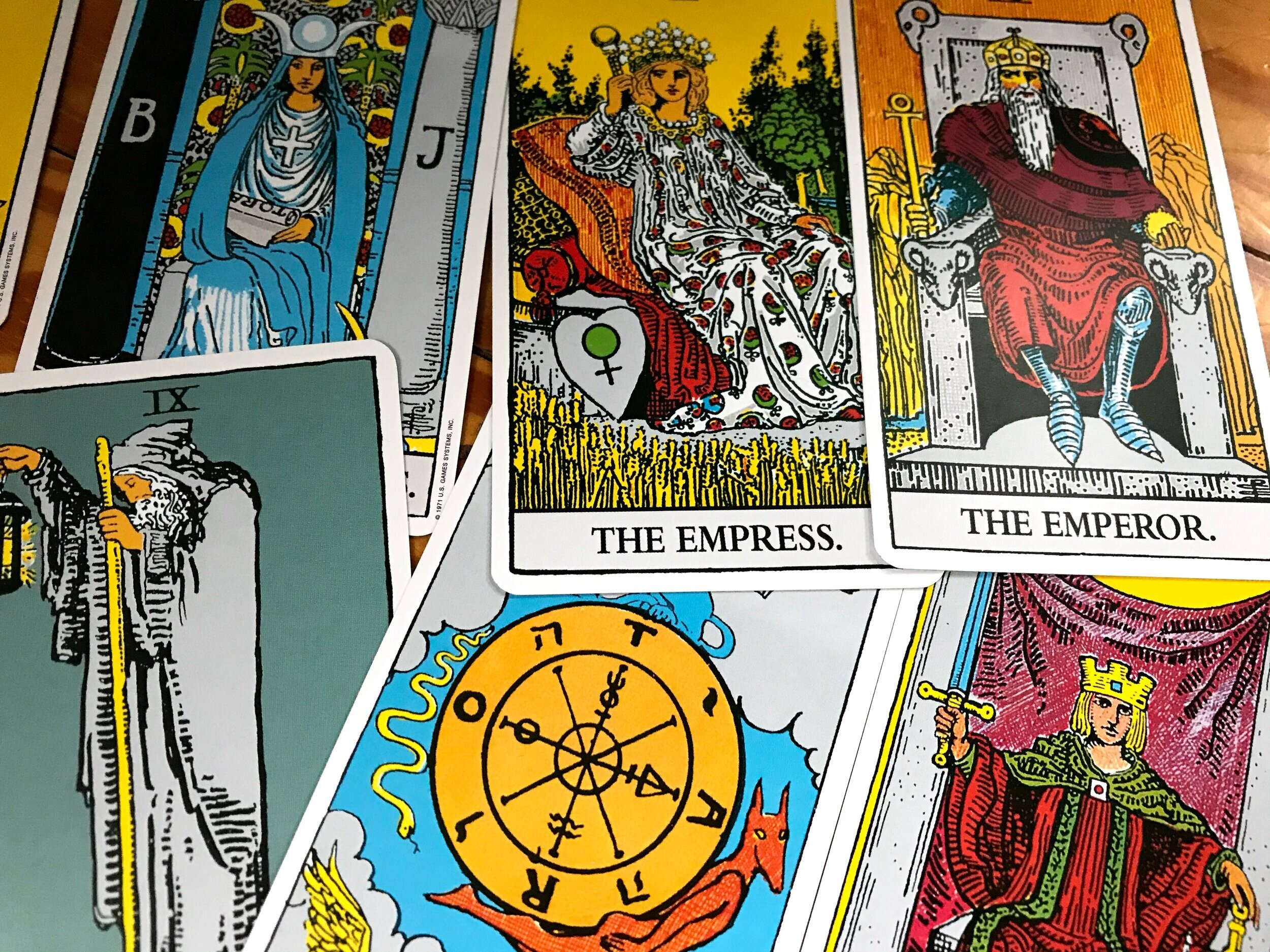
Remote Tarot Sessions. Email me a question, situation or issue. Based on the nature of your question, I’ll select a deck and pull a spread just for you. I’ll email you a photo of your cards and a voice-recorded reading.
Card of the Month: The Hierophant
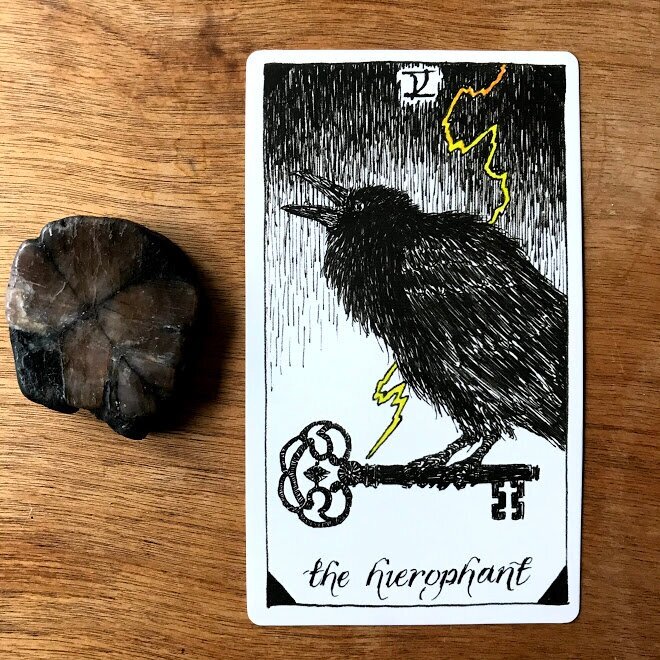
A hierophant is someone who interprets sacred mysteries. (If you’re like me, you had no idea what a hierophant was when you first read the word.) In this depiction, a black bird, feathers ruffled from a downpour, clutches a key charged with the lightning of truth. His beak is open, delivering the special message to anyone who will listen.
We can think of the Hierophant as representing all the rules we learn in life—from our family (what emotions are okay and how to express [or not express] them), our schooling (who and what is important enough to study and what intellectual authority looks like), religious community (who the chosen ones are, what right and wrong is), media (who gets to speak, be seen, and tell the culture’s stories), and our sociopolitical context (who’s in charge and who gets to have what). In addition to learning what’s okay and expected of us, we also learn the costs for stepping outside of the rules: shaming, bullying, isolation, rejection, violence. This whole process—learning what things mean, what the rules are, and the costs for breaking them—is called socialization.
We don’t need to be aware of our socialization for it to function. In fact, it “functions” better when we aren’t aware of it. Examples of some of the systems and narratives that we’re socialized into in the US are white supremacy, racial capitalism, patriarchy, individualism, scientific materialism, rationalism, dominance over nature, and meritocracy. These stories are packaged and transmitted seamlessly, through family, school, friends, and culture in every form—from wordless looks, silence, tacit disapproval, and judgment to educational curricula, mass media, popular culture, as well as through praise, recognition, and advancement.
The extent to which we’re unaware of these stories—the stories we receive without asking, stories knit into the fabric of not just our minds but also our bodies, cells and nervous systems—is the extent to which we participate in and perpetuate systems that exploit and oppress people based on race, gender, class, gender identity, sexuality, physical ability, age, education. There’s no such thing as being “neutral.” We’re either actively working against systems of oppression and exploitation, or we’re complicit in them.
If it’s new to us, it can sound harsh. And our rational minds have no trouble cobbling together a defense of ourselves and the people we love as “good people” who aren’t “like that.” The good/bad person binary is a trap; we contain the full range. And we are “like that.” That’s what makes socialization so powerful, and dangerous—there’s no getting outside of it, for any of us. It’s the water we all swim in. So now what?
I think it’s important to appreciate that people—largely the most marginalized, i.e. Black women and black queer and trans people—have been out there doing the hard work of creating a more just and equitable world (which would benefit all of us) for a long time. In the past few years, many people—like me—who’ve had the luxury of living in bubbles with the like-minded, are finally feeling the pain. We are rightly and properly scared for ourselves, our children and grandchildren, and the future of the only home any of us have.
It can feel tempting to roll over and go back to sleep; it’s too big, too scary. Or to feel hopeless and powerless in not being able to muster a grand gesture to “fix” all of it. Or to burn ourselves out and bypass our own pain trying to “save” the world.
I don’t actually have any answers. I am asking the question and wrestling deeply with the tension between experiencing joy and pleasure in the daily miracles of life—hot water coming out of the tap, a warm house on a winter night, loved ones who are healthy and well, food in the fridge, gas in the tank—alongside the harsh realities of global capitalism, environmental collapse, and the rise of white nationalism.
Yes, we inherit a lot of stories that we never would have chosen. And we also get to live into and tell new stories, different stories. Better stories. Stories of belonging and connection, of relationship and repair, of tenderness and curiosity, solidarity and resilience, abundance and reverence, justice and liberation. We can live these stories in our families and communities, our workplaces, churches and temples. We can live them in ourselves, in our own bodies. And we can widen the circle of who our community is. It’s not enough to be “good.” We have to recognize our sphere of influence and act there—intentionally, not impulsively.
There is so much in life that we do not get to control. But let us not underestimate or diminish the power we do have. Today, I can think, speak and act in alignment with my values. I can break silences and speak loving truth, even when it’s scary. I can see clearly (and excruciatingly) the ways I re-enact and inflict my deepest wounds on the people I love the most. Seeing how that whole system functions, I can choose to participate in my own healing and transformation. Where else do we start when the problems are so big?
Find out more about my tarot work, or schedule a tarot session.
WHAT’S INSPIRING YOU NOW?