July 2020: Change is In the Air
Hello friends,
I hope this summer finds you and your loved ones safe and healthy amidst the COVID-19 pandemic, the uprising of the Movement for Black Lives and all the ways our society’s systems are showing their seams.
Thanks to you, I was able to raise almost $200 for the Loveland Foundation through the painting raffle and $250 for the Tarot-Thon for Black Lives. The Golden Dome’s Tarot-Thon as a whole raised over $12,000, and we’re doing it again this month. I hope you’ll consider booking a reading (details below).
I’ve spent the last many weeks re-evaluating the ways I am doing my work in the world. After much reflection, I have decided to change the way I run Shea in the Catskills. I am not interested in running a business. Rather, I long to live a contemplative life within my community, doing my tarot, creative and social justice work outside the world of social media and capitalist modes of production and accumulation.
Many factors contributed to my decision—one being the tradition of not charging money for spiritual work. I am finding that I enjoy practicing tarot most when I am doing it as a gift or to raise money for a larger cause. As such, I will no longer be offering private tarot sessions by Zoom, but rather will be offering remote readings in written form; you can read more about that on my website.
Social media has been an amazing resource for inspiration and connection these past couple years. It has also become clear that for me, it is an addictive drain on my time and energy that keeps me from focusing wholeheartedly on my most important work and relationships. I will continue to maintain my website and send out newsletters as I feel called to. I will post Card of the Day writings and new artwork on my blog. And I continue to be interested in hearing from you about what’s inspiring you and what you’re learning during this time in our world.
To answer some questions you might have:
When will you be leaving social media?
Following this month’s Tarot-Thon on July 11th—see below about how to book a session, the last real-time sessions I’ll be doing for the foreseeable future—I’ll take leave of my social media accounts.
How do I get a tarot reading from you?
You can read more about what my current tarot work looks like at the tarot page on my website.
Will you still be selling your artwork?
Yes—my online shop will remain open, and I will add new items as I create them. I will donate 25% of the proceeds from the sale of my artwork to the Phoenicia Food Pantry, and 25% to BIPOC-centered organizations offering direct services to Black trans folks. I will use the remaining 50% to purchase materials and supplies, and to support my ongoing training and education through workshops, classes, and private instruction.
How are you going to make a living?
When I lived as a monastic, I relied on the sangha, or community, for material support. As a lay practitioner, I have the expenses of a householder. But they are modest, and my part-time job helps cover them for the most part. It’s my hope that some of you will be interested in supporting the work I do by becoming a patron or purchasing artwork. I am trusting that through my part-time work and community support, I can continue focusing on my spiritual, creative, and political work in a way that doesn’t require me to produce and sell, but rather allows me to dive deep, learn and offer.
How can I support your work?
To make a one-time donation, you can use my tip jar. To support my work in a more ongoing way, I encourage you to become a patron. You can also purchase original artwork in my online shop. And you can let people who you think might be interested in my work know that they can sign up for my newsletter on my website.
To all of you who have been supporting my work all along, through purchasing artwork and tarot sessions, through donations, likes and comments—thank you. It means the world to me.
Wishing you and your loved ones safety, happiness, health and peace as summer deepens.
With love,
Shea (aka Zuiko Ikusei)
she/they [why is this here?]
sheainthecatskills.com
What’s Inspiring Me Now
- A History of Women Mystic Artists: Ritual, Channeling & Healing with Natalie Labriola. Yes, it costs $11 to watch, but Labriola has done an enormous amount of work to recover this lineage of women artists. I keep watching it—it’s amazing!
- The Movement for Black Lives
- Mariame Kaba: Moving Past Punishment episode from the For The Wild podcast
- The email newsletters of Sarah Faith Gottesdiener, Amanda Yates Garcia, Chani Nicholas, Carrie Mallon, Pixie Lighthorse, Maria Minnis, Mystical Mandrake Root and Francesca DeGrandis
What’s inspiring you now? I would love to hear about it and include it in my next newsletter…
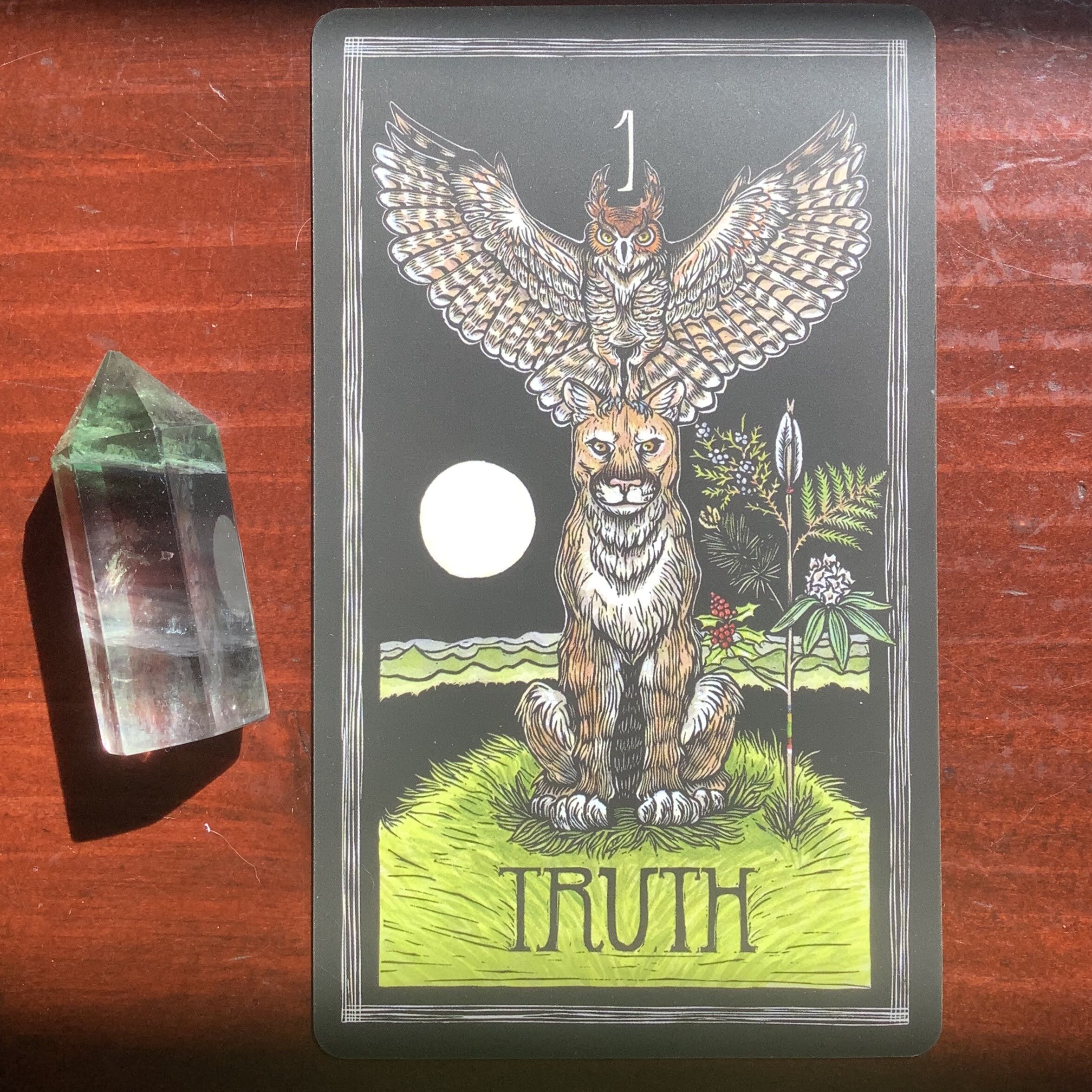
Card of the Month: Ace of Arrows (Swords)
In this striking depiction from The Brady Tarot, artist Emi Brady presents a mountain lion and a great horned owl, so seamlessly merged as to appear as one creature. On the left is the luminous full moon; on the right, a single arrow from which grows five plants sacred to the Cherokee, the original inhabitants of the Appalachian mountains. The lion and the owl look right at us. How do we experience their steady, direct gaze—as a challenge? An invitation? An offering? An indictment? A plea?
Aces are considered gifts, containing the full potential of their suit, which in this case is the realm of the mind. Arrows (or Swords, in other decks) call in our intellect, our wisdom, cognition, perception, awareness and attention, truth, justice and communication. It is the element of Air—quick-moving, visible only through its effect on and relationship with other things: the wind in the leaves, our breath, our voice. In the Ace of Arrows, we catch a glimpse, a flash of insight into the true nature of things. Emi Brady has chosen the keyword “Truth” here.
While the suit of arrows/swords conveys a masculine/yang energy, Emi has grounded her depiction in the yin energy of Earth and Water as well, through the growing plants and the full moon. Abstract, intellectual truth is partial. The interpenetration of masculine/yang and feminine/yin elements is how truth becomes fully integrated, embodied, and functional in our life.
I’ve been having conversations lately, mostly with white folks, about our stories, our racial journeys to this current moment: How did we learn about race? When did we first realize we were white? Where did our people come from, and why? How are we coming to terms with our history? It’s something I’ve been reflecting on a lot.
My freshman year of college, I took an Intro to Women’s History course. For our final exam, we analyzed a history textbook as if it were a novel—major themes, minor themes, characters (main and marginal), point of view, etc. And in that single assignment, I realized that throughout my primary and secondary education, I’d been lied to. Or, perhaps more accurately, I’d been brainwashed. At that time, I didn’t have enough life experience to ask it as a spiritual question, and so my question was academic: What is true?
I transferred into a school that let me create my own major around politics and storytelling, and I studied the intersections of race, gender, sexuality and class through novels, films, medieval literature, music, poetry, speeches, Greek epics, and critical race theory. Because it wasn’t just that the story I’d been told my whole life wasn’t true, it was that it was told that way for a reason. All stories are about power. And once I started seeing that, I couldn’t stop seeing it—the way that who gets to tell the story was essential to who has the power. And this functions throughout the long history of oppression and resistance to that oppression.
Several years ago, while I was living at the Monastery, I took an online course about anti-oppression facilitation that included reading The Characteristics of White Supremacy Culture by Kenneth Jones and Tema Okun. As I read it over, I felt a coldness spread throughout my body: I was reading a description of myself. The things that I had strived to be—and been rewarded for—throughout my whole life, I was now learning, were not just soaked in white supremacy, but were white supremacy itself. Everything that I thought was out there, in “those people,” was running through my own veins. I wondered: Who am I apart from this, underneath this programming? A question that was once abstract deepened into the personal, the spiritual.
Asking this question deeply, it became easier to work with certain aspects of what I always thought was my “personality,” because I could frame it in terms of anti-racist practice. When I led the chanting in the zendo and started tightening up when I thought it was going badly, I would remember: perfectionism. And practice softening, relaxing. I began to recognize my perfectionism as oppressive to myself and others. Working with it became not just a matter of my psychological well-being or my relational skill, but a spiritual matter: uprooting white supremacy from the inside. The more deeply I worked with these aspects of myself, the more I began to see the inherent spiritual and creative nature of anti-racist work.
In every moment, I have access to my body and mind—to the tension and activation that I’m coming to recognize as the signal and signature of white supremacist conditioning: around knowing, being right, being good, and being in control. It’s helpful for me to remember that my re-humanization depends on understanding the profound spiritual nature of uprooting systems of oppression. Not because I should, or it’s good to, or it helps someone else. But because my own liberation and humanity depends on it. Is this internal, spiritual work enough? That is for each of us to decide. For me, I need to balance it with taking action in the world, and doing this is its own profoundly creative practice.
So as I see calls from the Movement for Black Lives to Defund the Police, I take actions in the world, and I also turn inside to see all the many gross and subtle ways I have internalized the culture’s systems of punishment, cruelty and shame—toward myself and others. How frequently and convincingly I think the problem is so obviously and clearly that person or those people, and bypass the monster in me. The inverse of this tendency is my longing for someone to show up at my door and tell me that I’m doing a good job, that I’m doing enough, that I’m a good person and they see it. It’s hard to contend with the messy complexity, the not-knowing, the no-clear-answers, the gaps between my values and my actions. Shame and blame, praise and approval (the Buddha had some things to say about this)—leashes around my heart-mind. But who is holding the other end of that leash?
In my Zen training, I never felt sure that I was seeing what I was supposed to be seeing, or that I was having the insights I was supposed to be having. Since leaving the monastery, I continue to sift through my experience to pull out the gifts of my training, so that I can use them. And I continue to pull out the thorns, the things that made me feel small and insecure, the leashes I put in other people’s hands, the power I gave others to tell me that I was good. Or bad. Or right or wrong.
In the last year, I’ve been learning to take the leash into my own hand. Sometimes I manage to take it off for a time. And then I get so uncomfortable that I reflexively put it back on. In moments of stress and anxiety, I sometimes hand it to someone else, always with mixed results. Liberation sounds amazing. But when you’re used to struggling and feeling small, all that space can feel scary.
I believe more than ever in the power of storytelling to heal and liberate. I’m learning that true stories are complex. I’m noticing the dangers of simplistic narratives—the ones I tell about myself and others, and the ones churned out through advertising, political propaganda, and love-and-light spirituality that ignores the profoundly political nature of all things. As I have conversations with the people in my life about what is happening in our world right now, it feels more important than ever to recover and weave together our stories, to tell them to ourselves and each other, to thicken them with difficult, perhaps seemingly contradictory, truths. And to use our creativity to tell stories of a world that doesn’t yet exist—a world in which everyone has enough, in which healing, justice and care are the organizing principles of our society, in which we return to a reverent and reciprocal relationship with the earth and all beings, sentient and insentient.
I’ll leave you with a quote from Natalie Labriola’s presentation on The History of Women Mystic Artists: Ritual, Channeling & Healing, because it is what is resonating deeply in my heart and mind right now:
Mysticism is rooted in the belief that direct knowledge of reality can be attained through your subjective experience. In a spiritual context, this means that you don’t need a mediator or an authority to tell you what’s true. To take it one step further, I think that it’s deeply related to animism, which grants subjectivity, and therefore inherent intelligence, to everything in the universe. To be a mystic is to see yourself as in relationship, or potential relationship, with everything on earth. Which goes against the standard Western paradigm that sanctions the objectification of the other—whether that’s people, or animals, or the planet that we live on. In this way, I see mysticism as inherently political. But rather than providing all the answers, I see it as a framework that empowers the individual to be with the mysteries of life, the unanswerable questions.
Find out more about my tarot work.
WHAT’S INSPIRING YOU NOW?